

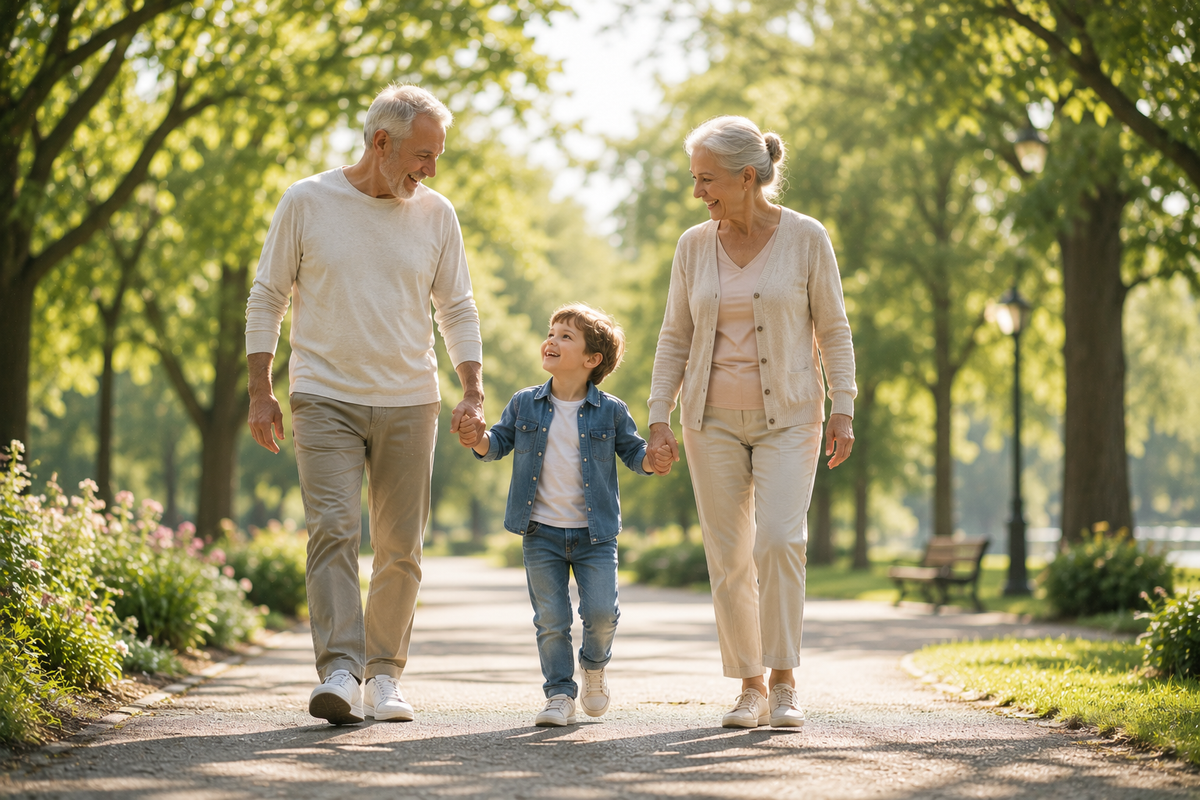
The way you move today is quietly shaping how you move tomorrow.
Many people do not begin thinking seriously about healthy aging because of the number on a birthday cake.
It often starts with a small moment of realization.
A full day of walking feels more tiring than it used to.
The pace slows slightly when climbing stairs.
Standing up after reaching down for something takes an extra moment.
These changes rarely happen overnight.
More often, they develop gradually through the routines and habits of everyday life.
That is why healthy aging is not something that begins after retirement.
It is a long-term process shaped by how we live today.
The way we sit, walk, rest, and make room for movement all contribute to the person we may become in the future.
Healthy Aging Is About More Than Age
When people hear the phrase “healthy aging,” they often think first about later life.
But healthy aging is not simply about how many years have passed.
It is about whether we can continue doing the things that matter to us through every stage of life.
It means feeling ready to travel with family.
Being willing to take a walk with friends.
Trying something new without immediately worrying that the body may not keep up.
Healthy aging is not about remaining exactly as we were when we were younger.
It is about preserving the ability to participate in life, enjoy new experiences, and respond to the changing demands of everyday living.
What matters most is not how young we appear.
It is whether the body can continue carrying us toward the places, people, and experiences that matter.
The Way You Live Today Is Shaping Your Future
Many people think about health as if it were an exam.
They wait until a medical checkup changes, or until the body begins to feel noticeably different, before deciding to move more, rest more, or adjust their daily habits.
But the body rarely changes all at once.
It is constantly adapting to the way we live.
When long periods of sitting and limited movement become the norm, the body gradually becomes accustomed to doing less.
When walking, stretching, standing up, and regular physical activity become part of daily life, the body also begins adapting to those demands.
Healthy aging is not achieved through one intense period of effort.
It does not begin at one particular age.
The ability to keep moving in the future is often shaped by ordinary decisions made today.

Walking a little farther.
Standing up more often.
Changing position instead of remaining still for hours.
The choices may seem small.
Over time, however, they become part of the body’s long-term relationship with movement.
Healthy Aging Does Not Mean Avoiding Age
Aging is a natural part of life.
Healthy aging is not about stopping time or asking the body to remain unchanged.
It is about helping the body continue responding to the needs of everyday life as those needs evolve.
Standing up.
Walking.
Turning.
Learning something new.
Traveling.
Working.
Spending time with family.
Facing unfamiliar challenges with confidence.
Healthy aging is not a fight against time.
It is a way of moving forward with it.
The body may change, but daily movement, recovery, and thoughtful choices can help preserve more possibilities along the way.
The goal is not to stay exactly the same.
It is to find a movement rhythm that continues to support life at every stage.
Everyday Mobility Depends on the Whole Body
Even the simplest daily movements require many parts of the body to work together.
Standing up from a chair is not only a task for the legs.
The ankles adjust position.
The knees and hips help shift body weight.
The core stabilizes the torso.
The back and upper body coordinate to complete the movement.
Walking, climbing stairs, carrying objects, and turning to reach for something all depend on the same whole-body cooperation.
That is why healthy aging is not only about maintaining strength in one area.
It is also about helping different parts of the body continue working together.
When daily movement becomes less frequent, the body has fewer opportunities to practice these patterns.
When walking, stretching, balance, and basic strength activities remain part of life, the body continues becoming familiar with them.
Mobility is never created by one muscle or one joint alone.
It comes from the whole body continuing to participate in life.
Begin Today by Making Movement Part of Life
Healthy aging does not have one fixed starting point.
What matters is not waiting until a certain age to begin.
It is being willing to make one small choice today that supports the future.
That choice does not need to involve high-intensity exercise.
It does not require changing every habit at once.
A routine that can be sustained over time often matters more than a dramatic short-term effort.
You can begin with simple habits:
Avoid staying in the same position for long periods.
Stand up, walk, or stretch after extended work sessions.
Set aside regular time for walking or physical activity.
Choose forms of movement you genuinely enjoy.
Increase activity gradually according to your current condition.
Allow enough time for sleep, rest, and recovery.
Pay attention to how the body feels and adjust when necessary.
There is no single formula for healthy aging.
Everyone has a different lifestyle, physical condition, and pace.
The goal is not to compare how much you do with someone else.
It is to find an approach you can continue, allowing movement to become a natural part of everyday life.
You May Not Notice It During Activity—But Your Body Does
Sometimes, the body becomes most noticeable after the movement is over.
After a walk, a stretching session, or a busy day, you may begin to notice:
●More fatigue in the legs than usual.
●A sense of engagement in the glutes or core.
●Stiffness in the shoulders or back after prolonged sitting.
●More noticeable breathing after climbing stairs.
Greater awareness of muscles that are rarely used.
These sensations may simply be part of the body readjusting to movement.
This is especially common after a long period without regular activity, or when daily movement gradually begins to increase.
The body often needs time to become familiar with different movement demands again.
However, if pain, swelling, numbness, or other significant discomfort persists, repeatedly returns, or begins to interfere with daily life, consult a qualified healthcare professional.
What Matters Most Is the Ability to Keep Participating in Life
Healthy aging is not a checklist of exercises.
It is not a condition that suddenly becomes important after reaching a certain age.
It is the ongoing ability to remain involved in everyday life.
Completing daily tasks independently.
Going out with family.
Having the energy to explore a new place.
Feeling confident enough to adapt when life changes.
Healthy aging is sometimes described as delaying change.
But an equally important goal is preserving choice.
The choice to go outside.
The choice to keep learning.
The choice to participate instead of stepping away.

What we are building is not simply a higher number of workouts.
It is the body’s continued ability to respond to life.
Designed for Everyday Movement
At Vital Salveo, we believe great wearable design should not belong only to moments of exercise.
It should also support the everyday act of standing up, walking, working, traveling, and spending time with the people who matter.
Everyone moves at a different pace.
Some people spend long hours standing.
Some move continuously between work and commuting.
Others are gradually rebuilding a regular walking or exercise routine.
The right wearable experience should not force the body to adapt to the product.
The product should move more naturally with the body.
Supporting every transition.
Every step.
And every rhythm that becomes part of daily life.
Our Wearable Design Philosophy
Every Vital Salveo product is built around three core design philosophies.
We believe ideal wearable design should do more than surround the body.
It should create a natural balance between comfort, fit, stability, and freedom of movement.
Whether during work, regular activity, exercise, or travel, the product should follow the body’s natural way of moving.
From material selection and three-dimensional construction to the overall wearing experience, every design decision begins with everyday human movement.
3D Dynamic Structure
Support That Moves With the Body
Every daily movement depends on different parts of the body working together.
3D Dynamic Structure combines ergonomic design, Dynamic Compression, and seamless three-dimensional knitting to create a balance between fit, stability, and freedom of movement.
The structure is designed to move naturally with bending, stretching, and shifts in body weight.
Not to restrict movement.
But to accompany the body through the activities of everyday life.
Thermal Trigger
Inspired by the Body’s Natural Warmth
The body naturally generates warmth during movement.
Thermal Trigger is Vital Salveo’s design concept inspired by the body’s natural activity.
Through the material characteristics of graphene and germanium, the design is intended to integrate naturally into work, walking, exercise, and everyday movement.
No external power source.
No additional equipment.
Just a design concept created to accompany the natural movement that continues throughout the day.
Photo Dynamic Modulation
Designed for the Changing Rhythm of Everyday Life
Together with 3D Dynamic Structure and Thermal Trigger, Photo Dynamic Modulation forms one of Vital Salveo’s three core design philosophies.
It represents our ongoing exploration of innovative materials, wearable comfort, and the quality of everyday movement—not any medical function or therapeutic purpose.
Everyone has a different rhythm.
Some people begin the day with a morning walk.
Some spend hours moving at work.
Others use small moments throughout the day to remain active.
Our goal is to create a wearing experience that feels natural, comfortable, and easy through every transition, step, and change in posture.
Healthy Aging Is a Way of Living That Begins Today
Healthy aging is not a future goal that waits for the right moment.
It can be found in the small decision to stand up and move today.
It can be found in choosing to care for the body, paying attention to how it feels, and making space for movement in everyday life.
The future is rarely shaped by one extraordinary effort.
It is shaped by habits that continue for years.
Walking a little more.
Stretching one more time.
Sitting a little less.
Keeping the body involved in life.
These choices may seem small, but together they quietly build future mobility.
Because healthy aging is not only about age.
It is about how we live today—and how we hope to continue living tomorrow.
Protect Every Movement.
Wake Up Your Body’s Potential.
Whether today involves work, exercise, travel, or simply sharing an ordinary day with family, every movement deserves care.
At Vital Salveo, we continue exploring wearable designs that work more naturally with the way the body moves.
Our goal is to support people who value movement and quality of life through every stage—so they can continue enjoying each day with comfort, confidence, and freedom.
Because great wearable design does not belong only to exercise.
It belongs to every step of life.


分享:
Why Doesn't Running Always Have to Be Fast?