

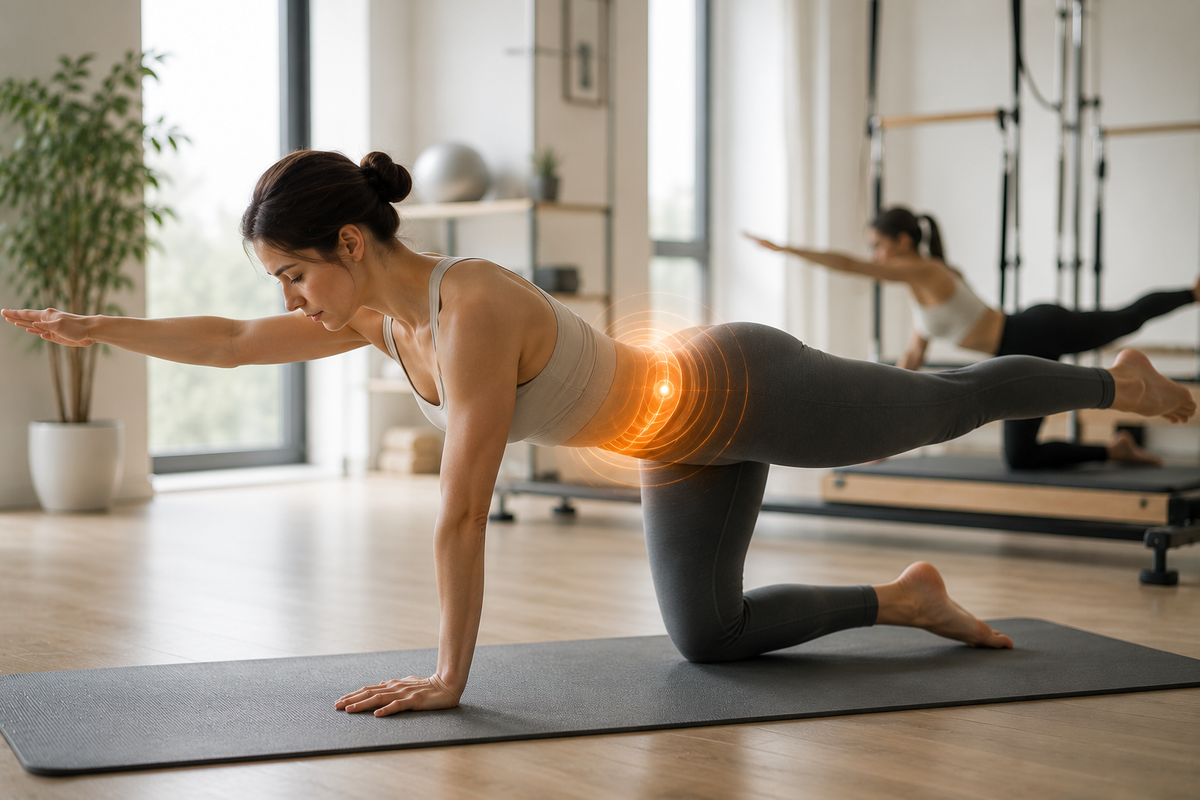
Sometimes, Your Body Is Learning More Than Strength—It's Learning Control.
For many people, their first Pilates class begins with the same thought:
"This doesn't look that difficult."
There are no explosive sprints. No heavy weights. No intense jumping or high-impact movements.
The exercises appear slow, controlled, and surprisingly simple.
Yet once the class begins, many people quickly realize that appearances can be deceiving.
Holding a position for just a few seconds may cause the legs to tremble. The core remains engaged, while the shoulders quietly begin to tense without even noticing.
Despite not feeling exhausted or drenched in sweat, by the end of class it often feels as though every part of the body has been involved.
Interestingly, the instructions Pilates instructors repeat most often are rarely things like:
"Move faster."
Instead, they are more likely to say:
"Relax your shoulders."
"Slow down."
"Keep breathing."
"Don't rely on momentum."
These reminders may sound simple, but they reflect the essence of Pilates.
Pilates isn't about completing more repetitions or achieving the biggest range of motion.
It's about developing a deeper connection between your body and your movement—through every breath, every stretch, and every transition.
Slow Doesn't Mean Your Body Is Resting
In many forms of exercise, intensity is often measured by speed, weight, or repetition.
Pilates takes a different approach.
Instead of moving faster, it deliberately slows everything down.
Each movement becomes clearer.
Every position asks for more control.
And without momentum to carry you through, your body has to do the work.
As class progresses, everyone slowly lifts an arm, extends a leg, or holds a seemingly simple position.
Within seconds, some people notice their legs beginning to shake.
Others instinctively want to speed up the movement.
Some unconsciously try to use momentum to make the exercise easier.

All of these reactions are completely normal.
Because Pilates isn't designed around moving quickly.
Instead, it challenges the body to maintain stability, balance, and control throughout every movement.
The longer a position is held, the more your body continuously adjusts its center of gravity, stabilizes the joints, and coordinates movement with breathing.
That's why the simplest-looking exercises often feel the most challenging.
The difficulty doesn't come from the movement itself.
It comes from maintaining precise control—without relying on speed, force, or momentum.
Breathing Is Part of Every Movement
If you've ever taken a Pilates class, one instruction probably sounds familiar:
"Don't hold your breath."
"Inhale slowly."
"Exhale before you move."
Many beginners become so focused on performing the exercise correctly that they don't realize they've stopped breathing altogether.
In Pilates, breathing isn't something separate from the movement.
It is part of the movement.
Breath doesn't simply accompany each exercise.
It provides rhythm.
It supports control.
It helps every stretch, every return, and every transition feel more stable and natural.
When instructors continually remind students to breathe, they aren't simply encouraging better breathing habits.
They're helping the body move with intention instead of rushing to finish the exercise.
As breathing becomes steadier, movement often becomes smoother.
And over time, awareness of posture, balance, and body control naturally begins to grow.
Pilates Is Really About Building Body Awareness
Many people assume that Pilates is primarily about developing a stronger core or becoming more flexible.
But after practicing for a while, they often discover that its greatest benefit lies somewhere else.
They begin to understand their own body more deeply.
They notice whether their shoulders habitually tense.
Whether they shift more weight to one side.
Whether their pelvis stays level during movement.
Whether their breathing truly matches the rhythm of each exercise.

These observations may seem small.
Yet they represent one of the most valuable skills Pilates develops—body awareness.
Throughout a single class, the body repeatedly performs movements that appear simple, yet require continuous attention and control.
For example:
Coordinating movement with breathing
Maintaining a stable core and pelvis
Controlling the slow extension and return of the limbs
Keeping balance evenly between both sides of the body
Relaxing unnecessary tension in the shoulders
Remaining stable during every transition
None of these movements are about achieving perfection.
They're about helping the body rediscover how different parts can work together more naturally.
As your body begins to understand how it moves—and how each area contributes to the whole—movement often becomes smoother, more balanced, and more comfortable.
Ultimately, Pilates isn't simply about mastering a sequence of exercises.
It's about developing a deeper understanding of your own body, and carrying that awareness into everyday life.
True Stability Is Built by the Whole Body, Not Just the Core
When people think about Pilates, the first thing that often comes to mind is core training.
But truly stable and fluid movement is rarely created by one muscle group alone.
From your breathing and core to your back, hips, glutes, shoulders, and legs, every part of the body works together to create balance, stability, and efficient movement.
Take a simple single-leg balance exercise as an example.
●Your abdominal muscles help stabilize your torso.
●Your glutes support your pelvis.
●Your hips make constant adjustments to your center of gravity.
●Your legs make countless subtle corrections to keep you balanced.
Meanwhile, your shoulders and neck remain relaxed, preventing unnecessary tension from affecting your posture.
No single body part performs the movement by itself.
●Every stretch.
●Every balance.
●Every transition.
They are all the result of different parts of the body working together.
That's why Pilates emphasizes much more than core strength.
It encourages the entire body to move with coordination, stability, and control.
As your body gradually learns this kind of cooperation, the benefits often extend well beyond the studio.
●Standing.
●Walking.
●Climbing stairs.
●Carrying groceries.
Even maintaining posture during long hours at a desk can begin to feel more natural and effortless.
The goal isn't simply to build a stronger core.
It's to help your entire body move as one.
Better Movement Begins Beyond the Studio
The benefits of Pilates don't end when class is over.
As people become more aware of their posture, breathing, and movement patterns, many begin to realize that the quality of their movement is shaped less by a single workout—and more by the habits they repeat every day.
Simple routines such as:
Sitting at a desk for long hours
Looking down at a phone throughout the day
Remaining in the same position for extended periods
Moving too little during daily life
Consistently favoring one side of the body
Neglecting regular stretching and recovery
may gradually influence the way the body naturally moves.
Some muscles quietly take on more work.
Others become less involved over time.
As these patterns accumulate, the body's coordination, stability, and overall movement quality may slowly begin to change.
That's why many people discover something surprising during their first Pilates class.
They notice that they habitually shift more weight onto one leg.
Their shoulders naturally rise without realizing it.
Or they rely on momentum instead of control when transitioning between movements.
Pilates doesn't create these patterns.
It simply slows everything down enough for you to notice them.
Beyond regular practice, small daily habits can also support better movement, including:
Taking regular movement breaks throughout the day
Stretching consistently
Practicing slow, steady breathing
Paying attention to posture while sitting, standing, and walking
Giving your body enough time to rest and recover
As these habits gradually become part of everyday life, your body is better able to move with balance, stability, and ease—whether you're exercising or simply going about your day.
If you're new to Pilates, or you're returning to exercise after surgery, pregnancy, chronic discomfort, or another health-related condition, consider consulting a qualified instructor or healthcare professional before beginning. They can help you choose an approach and intensity that best suits your individual needs.
You Didn't Notice It During Class—But Your Body Did
For many people, the real sensations of Pilates don't appear until after class.
Once the workout is over, they may begin to notice:
A gently fatigued core
Tightness in the thighs or glutes
Mild soreness in the shoulders or back
Slight muscle trembling
Greater awareness of muscles they rarely noticed before
Interestingly, these sensations don't always appear while you're exercising.
During class, your attention is often focused on breathing, posture, and movement control.
It's only afterward—perhaps while driving home, relaxing in the evening, or even the next morning—that you begin to realize just how many parts of your body were involved.
Experiencing mild shaking, muscle fatigue, or light soreness is not uncommon when you're new to Pilates, returning after a break, or gradually increasing your training intensity.
In many cases, these are simply signs that your body is adapting to new movement patterns and learning to coordinate different muscle groups more effectively.
However, if shaking, pain, or discomfort persists, repeatedly returns, or begins to interfere with daily life, it's important to seek advice from a qualified healthcare professional.
Designed for Every Intentional Movement
At Vital Salveo, we believe great wearable design should never restrict the body.
It should move with it.
Pilates reminds us that every movement has its own rhythm.
Every breath has its own purpose.
And every transition deserves thoughtful attention.
Inspired by this philosophy, we continue exploring how thoughtful materials, ergonomic construction, and innovative design can create a wearing experience that feels natural, comfortable, and supportive.
Our goal isn't simply to accompany you during exercise.
It's to become part of every movement throughout everyday life.
Our Wearable Design Philosophy
Every Vital Salveo product is built around three core design philosophies.
We believe effective wearable design isn't about restricting movement.
It's about supporting the body while allowing it to move naturally.
Whether you're practicing Pilates, walking through your daily routine, or enjoying an active lifestyle, every detail is designed to balance comfort, stability, and freedom of movement.
From carefully selected materials to three-dimensional construction and ergonomic design, every decision begins with one idea:
Movement should feel natural.
3D Dynamic Structure
Support That Moves With Every Controlled Motion
Pilates isn't built around speed.
It's built around precision, stability, and control.
Wearable support should reflect the same philosophy.
Rather than limiting movement, it should adapt to every stretch, every balance, and every transition.
Our 3D Dynamic Structure combines ergonomic design, Dynamic Compression, and seamless knitting technology to create a comfortable balance between support, flexibility, and freedom of movement.
Whether you're practicing Pilates, commuting to work, traveling, or simply moving through daily life, it's designed to move naturally with your body.
Thermal Trigger
Inspired by Your Body's Natural Warmth
Your body naturally generates warmth whenever you move.
Thermal Trigger is Vital Salveo's design philosophy inspired by that natural process.
By incorporating the material characteristics of graphene and germanium fibers, the design responds naturally to changes in body temperature generated through everyday movement.
No batteries.
No charging.
No external devices.
Just a design concept that integrates naturally into your daily wearing experience—whether you're practicing Pilates, walking outdoors, working at your desk, or traveling.
Photo Dynamic Modulation
Designed Around Everyday Movement
Together with 3D Dynamic Structure and Thermal Trigger, Photo Dynamic Modulation forms one of Vital Salveo's three core design philosophies.
It represents our ongoing exploration of innovative materials, wearable comfort, and movement-focused design—not any medical function or therapeutic purpose.
Rather than focusing only on exercise performance, we aim to create products that naturally fit into every part of daily life.
From controlled breathing and mindful movement during Pilates to work, travel, and everyday routines, our goal is to provide a lightweight, comfortable wearing experience that moves naturally with you.
Every Intentional Movement Deserves Better Support
Pilates teaches us that progress isn't always measured by performing more difficult exercises.
Sometimes, progress is found in something much quieter.
A steadier breath.
A more balanced posture.
A deeper understanding of how your body moves.
As you become more aware of your movement, every intentional step, stretch, and transition becomes part of everyday life.
●Every breath.
●Every stretch.
●Every controlled movement.
●Every shift of balance.
●Every natural step.
They all happen because different parts of the body work together as one.
That's why we don't simply design wearable products.
We design them to accompany people through work, exercise, travel, and every moment in between.
Because every intentional movement deserves thoughtful support.
Protect Every Movement.
Wake Up Your Body's Potential.
The next time you step onto a Pilates mat, you may discover that you're practicing more than movement alone.
You're learning to understand your breathing.
Your posture.
And the way your body naturally moves.
At Vital Salveo, we continue exploring materials, construction, and wearable design that work in harmony with the body's natural movement.
So you can move with greater confidence, comfort, and freedom—through every stage of life.
Because great wearable design doesn't belong only in the studio.
It belongs in every movement, every day.


Share:
Pickleball Is About More Than Swinging a Paddle