

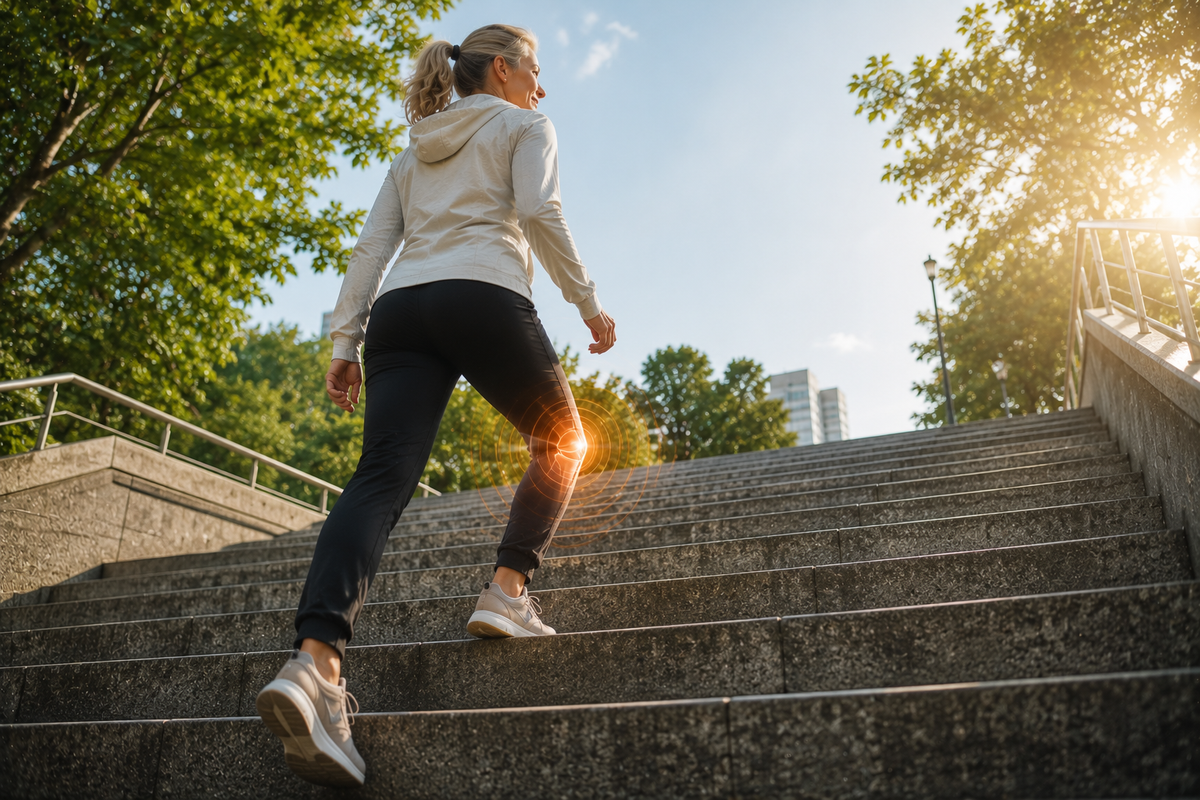
Your legs are not the only part of the body working together.
Climbing stairs is something many people do every day.
Walking up from a subway station.
Returning home.
Moving through an office, school, shopping center, or travel destination.
Because stairs are so common, most people rarely stop to notice how the body actually completes the movement.
Until one day, the legs begin to tire more quickly.
A few steps feel enough to require a pause.
Or a movement that once felt smooth begins to feel hurried, unsteady, or less natural.
That is when we begin to realize that climbing stairs requires far more whole-body cooperation than it may appear.
Climbing stairs is not simply a matter of lifting one foot and placing it on a higher step.
From placing the foot securely, to supporting body weight, to moving the center of gravity forward and upward, each stage requires different parts of the body to participate in sequence.
What makes stair climbing feel difficult is not always the height of the steps or the number of floors.
Sometimes, the more important question is this:
Can the body maintain a natural, stable, and sustainable movement rhythm through every shift in weight?
Climbing Stairs Looks Simple, but It Requires More Coordination
When walking on level ground, the body primarily moves forward.
When climbing stairs, the body must move both forward and upward.
That change in height requires each step to involve more control and coordination.
When one foot reaches the next step, the opposite side of the body first needs to remain stable.
The foot must find a secure position.
The ankle adjusts to the height and angle of the step.
The knee and hip bend to prepare the body for upward movement.
Then the glutes, legs, and core work together to move body weight from a lower position to the next level.
These actions happen quickly.
So quickly that we rarely notice them in daily life.
But lifting, placing, supporting, pushing, and balancing all need to occur in sequence.
When the body completes these actions naturally, stair climbing may look like a simple series of steps.
When one part does not participate smoothly, however, the body may begin using another strategy to complete the movement.
Every Step Up Requires the Whole Body
Climbing stairs is not simply a matter of the thighs pushing the body upward.
Every step is the result of the entire body working together.
The foot makes contact with the step and establishes a stable base.
The ankle responds to the step height and body position, helping control placement and weight transfer.
The knee bends and extends as body weight shifts.
The hips and glutes contribute to moving the body forward and upward.
The core stabilizes the torso, reducing excessive leaning or side-to-side movement during the transition.
The upper body and arms also contribute to balance.

Even without an obvious arm swing, the shoulders, back, and torso continue coordinating with the lower body.
These areas do not work independently.
They cooperate from one step to the next.
●Place.
●Support.
●Push.
●Balance.
Then prepare for the next step.
What moves the body upward is never the strength of one area alone.
It is the ability of different areas to participate together at the right time.
Tired Legs Do Not Always Mean the Legs Are the Only Area Involved
Feeling fatigue in the legs after climbing stairs is common.
But it does not always mean the legs are the only area that deserves attention.
When the core does not stabilize the torso effectively, the body may lean too far forward, causing the legs to take on more work.
When the hips and glutes do not participate smoothly, the knees or front of the thighs may need to contribute more effort.
When the foot does not land securely, or the ankle does not control the position well, the body may also use extra tension to maintain balance.
Some people pull themselves upward with the handrail.
Some repeatedly rely more on one side.
Others spend less time supporting weight on one leg and quickly bring the opposite foot to the next step.
These strategies may help the body complete the movement in the moment.
But they may also show that the body is searching for another way to manage the task.
That is why, when stair climbing begins to feel unusually difficult, it may be helpful to observe more than leg strength.
Consider whether:
●The foot can make stable contact with the step.
●The body is leaning excessively forward.
●Both sides can alternate naturally.
●The core can keep the torso steady.
●Breathing can keep pace with the current speed.
●Each step still feels controlled.
●Climbing stairs is a whole-body movement.
When it becomes difficult, it should also be understood as a whole-body task.
Find a Stair-Climbing Rhythm That Suits You
Speed is not the only thing that matters when climbing stairs.
Some people prefer taking two steps at a time to arrive more quickly.
Some begin moving faster without noticing when they are in a hurry.
Others lean the upper body far forward in an attempt to move upward more easily.
These approaches may not suit everyone.
When the step height or stride exceeds what currently feels manageable, the hips, knees, and core need to provide more control.
When the pace becomes so fast that the body has not completed one weight shift before preparing for the next, the movement may become rushed and less organized.
There is no need to compare your speed with someone else.
You do not need to climb higher with every step to prove greater movement ability.
What matters more is placing the foot securely.
Allowing body weight to move gradually forward and upward.
And adjusting breathing, step length, and speed according to how the body feels that day.
A suitable rhythm gives the body enough time to place, support, and push through each step.
It is not about leaving the previous step as quickly as possible.
It is about allowing the body to prepare before moving to the next one.
Slowing down does not mean lacking ability.
Sometimes, it is simply how the body regains control.
Each Step Is About Movement Quality, Not Finishing Speed
When climbing stairs, it is easy to focus only on how many steps remain.
But this can make us overlook how the body is moving upward.
Lifting the foot higher is not always better.
What matters is whether the foot can reach a stable position naturally.
Leaning farther forward does not always make movement more efficient.
What matters is whether the torso remains controlled while moving.
Avoiding the handrail does not automatically mean better ability.
What matters is choosing a safe approach based on the environment and your current condition.
Moving faster does not automatically mean better movement quality.
More useful things to observe include:
●Whether each step feels stable.
●Whether both sides alternate naturally.
●Whether the body moves excessively from side to side.
●Whether breathing remains smooth.
●Whether the foot lands with control.
●Whether noticeable tension is required to continue.
When steps become disorganized, landings become heavier, the body leans far forward, or the upper body must pull strongly to move upward, the current pace or step length may be beyond what feels appropriate.
At that point, completing the staircase quickly may be less important than reducing speed.
Let the breathing settle.
Check where the foot is placed.
Then continue according to your own rhythm.
You May Not Notice It While Climbing—But Your Body Does
During stair climbing, attention is often focused on reaching the destination.
Only after stopping do different parts of the body become more noticeable.
You may experience:
●Noticeable fatigue in the front of the thighs or glutes.
●Greater activity in the calves and ankles than during level walking.
●Fatigue in the core or back after a longer staircase.
●More noticeable breathing and heart rate than during ordinary walking.
●Different sensations between the left and right sides.
●A change in stability when the handrail is released.
These sensations may occur when stair climbing is not part of your usual routine, when activity levels are increasing again, or after climbing a longer series of steps.
In many cases, they may reflect the body adapting to a higher range of leg movement, greater weight transfer, and continued upward motion.
However, if you experience persistent pain, noticeable swelling, numbness, dizziness, chest discomfort, unusual shortness of breath, or any other symptom that affects daily life or movement safety, stop the activity and seek evaluation from a qualified healthcare professional.
Climbing Stairs Is Part of Everyday Mobility
For many people, climbing stairs is simply an ordinary part of life.
But stairs appear in homes, bus stations, subway exits, offices, schools, shopping centers, and travel destinations.
Some staircases have only a few steps.
Others continue for several floors.
Sometimes there is time to move slowly.
Sometimes you may be carrying bags or other objects.
Some steps are higher or narrower.
Some environments may be crowded, poorly lit, or require quicker reactions.

The body must adjust differently in each situation.
That is why the ability to change speed, foot placement, and weight distribution according to the environment is also part of everyday mobility.
What matters is not how quickly or how high you can climb in one attempt.
It is whether you can complete the movement safely and appropriately across different situations.
When the body is familiar with lifting, placing, supporting, and pushing upward, and different areas can cooperate naturally, stair climbing begins to feel less demanding.
That sense of ease creates more freedom in daily life.
It also preserves more choices in work, commuting, travel, and time spent with family.
Let Upward Movement Become Part of Everyday Life
Maintaining the ability to climb stairs does not mean challenging yourself with a large number of steps every day.
What matters more is giving the body regular opportunities to experience different forms of movement.
You can begin with simple habits:
Choose a short staircase when you are not in a hurry.
Begin with a number of steps you can complete steadily.
Use a slower pace while the body becomes familiar with the movement.
Place as much of the foot as possible securely on each step.
Avoid skipping too many steps simply for speed.
Use the handrail when it supports safety and stability.
Slow down when carrying objects and keep the steps within view.
Pause when breathing becomes hurried or the steps feel unsteady.
Choose stairways that are well lit, clearly visible, and safe.
Everyone has a different level of activity.
Some people may comfortably climb one floor at a time.
Others may be better suited to completing the stairs in shorter sections.
What matters is not completing the same number every day.
It is allowing activity to build gradually according to the body’s condition.
When stairs become more than a route passed through in a hurry, and instead become a familiar daily movement, every step upward can become part of staying engaged with life.
What Matters Is Completing Each Step With Confidence
Some paths in life move forward.
Others require us to move upward, one step at a time.
The stairs we pass every day may seem ordinary, but they appear throughout work, commuting, travel, and time with family.
Climbing stairs is not about taking the highest possible step.
It is not about finishing the entire staircase as quickly as possible.
It is a whole-body movement that requires coordination, adjustment, and a natural rhythm through every shift in weight.
Sometimes, the body can move smoothly through the entire staircase.
Sometimes, the pace needs to slow.
Sometimes, using the handrail or pausing briefly is the more appropriate choice.
What matters is not performing the same way every time.
It is understanding your condition and choosing a way to continue that suits the moment.
When you find your own rhythm, each step becomes steadier.
When activity becomes part of life, each day also contributes to future mobility.
What matters is not being the fastest today.
It is still being able to meet every upward path in life with confidence many years from now.
Designed for Every Step Up
Designed for Every Upward Movement
At Vital Salveo, we believe great wearable design should not only accompany forward movement.
It should also respond naturally to leg lifting, foot placement, and every upward shift in body weight.
Whether during commuting, work, travel, or the stairways of everyday life, everyone has different movement needs.
Some people value comfort and fit during longer periods of activity.
Some want a stable wearing experience while moving up and down stairs.
Others care about breathability, flexibility, and whether a product fits naturally into everyday clothing.
The right wearable experience should not require the body to adapt to the product.
The product should respond to each bend, extension, and change in weight.
Supporting the body as it moves upward at its own pace.
Our Wearable Design Philosophy
Every Vital Salveo product is built around three core design philosophies.
We believe ideal wearable design should do more than surround the body.
It should create a natural balance between comfort, fit, stability, and freedom of movement.
Whether during stair climbing, walking, work, travel, or everyday life, the product should follow the body’s natural way of moving.
From material selection and three-dimensional construction to the overall wearing experience, every design decision begins with human movement.
3D Dynamic Structure
Support That Responds to Every Shift in Weight
The body does not remain in one fixed position while climbing stairs.
From lifting the foot and placing it securely, to bending the knee and hip, and then moving body weight forward and upward, each stage requires different joint angles and ranges of motion.
3D Dynamic Structure combines ergonomic design, Dynamic Compression, and seamless three-dimensional knitting to create a balance between fit, stability, and freedom of movement.
The structure is designed to respond naturally to lifting, stepping, bending, and shifting body weight.
Not to restrict upward movement.
But to accompany every step as it naturally happens.
Thermal Trigger
Inspired by the Body’s Natural Warmth
The body naturally generates warmth during movement.
Thermal Trigger is Vital Salveo’s design concept inspired by the body’s everyday activity.
Through the material characteristics of graphene and germanium, the design is intended to integrate naturally into commuting, walking, stair climbing, and the changing movement demands of daily life.
No external power source.
No additional equipment.
Just a design concept created to accompany the natural movement that continues throughout the day.
Photo Dynamic Modulation
Designed for the Changing Rhythm of Everyday Activity
Together with 3D Dynamic Structure and Thermal Trigger, Photo Dynamic Modulation forms one of Vital Salveo’s three core design philosophies.
It represents our ongoing exploration of innovative materials, wearable comfort, and the quality of everyday movement—not any medical function or therapeutic purpose.
The stairs we encounter in daily life are not always the same.
Sometimes, there are only a few steps outside the front door.
Sometimes, a subway exit requires a much longer climb.
On other days, work and travel may involve going up and down stairs repeatedly.
Our goal is to create a wearing experience that feels natural, comfortable, and easy through every start, leg lift, shift in weight, and upward movement.
Every Step Up Deserves Better Support
Climbing stairs is about more than completing an upward route.
It reminds us that every natural movement depends on different parts of the body working together.
Sometimes, slowing down allows the body to regain stability.
Using the handrail can make the movement feel more secure.
Pausing at the right time can help the next step remain controlled.
What is worth building is not one fastest time.
It is the body’s continued familiarity with lifting, placing, and moving upward.
Step by step.
Day by day.
Continuing according to your own condition.
Because the best rhythm is not the speed other people notice.
It is the way of moving that helps you reach more floors—and more of what life has to offer.
Protect Every Movement.
Wake Up Your Body’s Potential.
Whether today involves commuting, work, travel, or simply climbing an ordinary staircase, every upward movement deserves care.
At Vital Salveo, we continue exploring wearable designs that work more naturally with the way the body moves.
Our goal is to support people who value movement quality as they complete each step across different moments of everyday life.
Because great wearable design does not belong only to exercise.
It belongs to every forward and upward movement in daily life.


Share:
Walking Is Not About Being the Fastest